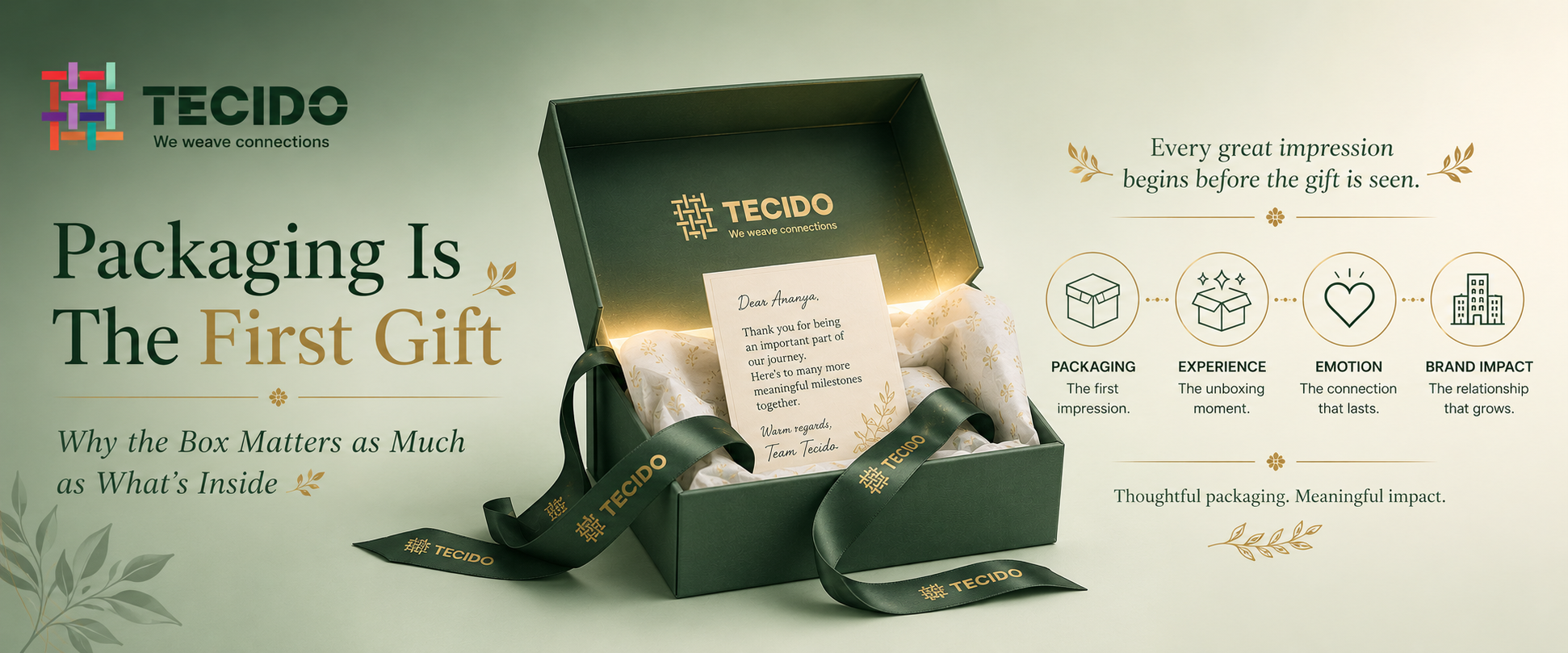
Packaging Is the First Gift: Why the Box Matters as Much as What's Inside
There is a moment, before the gift is seen, before the product is touched, that determines the entire impression a corporate gift will make. It is the moment of first contact — picking up the package, feeling its weight, seeing the box, reading the label.
Most companies invest significant thought in what goes inside a gift and almost no thought in what the recipient experiences before they get there. This is a strategic mistake, because the packaging is not secondary to the gift — it is the first gift.
Why packaging creates disproportionate impact
Human beings make emotional judgements about quality within seconds of first contact with an object. The weight of a box, the texture of the paper, the crispness of a brand mark, the way a lid opens — all of these signals communicate quality before a single product is seen.
Research on consumer psychology consistently shows that premium packaging increases perceived product value by 20–30%, even when the underlying product is identical. In corporate gifting, where the gift is representing your company's brand, this effect is amplified. A beautifully packaged gift says: we are the kind of company that cares about how we show up in the world. An unimpressive package says the opposite — even if what is inside is excellent.
The anatomy of exceptional corporate gift packaging
The outer box
The primary container sets the tone for everything that follows. Rigid gift boxes in brand colours, with a cleanly printed or embossed logo, signal premium quality immediately. Corrugated shipping boxes, even if the product inside is excellent, undermine the gifting experience before it begins.
Consider: the weight and thickness of the box wall, the precision of the printing, whether the lid closes with a satisfying firmness, and whether the exterior colour and finish align with your brand identity.
The interior presentation
How the contents are arranged inside the box creates the unboxing moment — the reveal that determines the emotional peak of the gifting experience. Key elements:
• Tissue paper or shredded fill — creates a sense of curation, of something carefully laid out rather than thrown in
• Product placement — the most premium or personal item visible first when the box is opened
• Insert card placement — the personalised card should be the first thing the recipient encounters, not buried at the bottom
• Colour coherence — tissue paper, ribbon, and inserts in brand colours creates visual harmony throughout
The personalised insert card
Of all the packaging elements, the insert card has the highest emotional impact relative to cost. A card that addresses the recipient by name, carries a genuine personal message (not a printed form letter), and is signed by a real person creates a human connection that no product can create alone.
Best practice: handwritten cards for tier-1 relationship gifts; printed personalised cards (with the recipient's name clearly included) for programme-scale gifting. Never a generic "Wishing you and your family a Happy Diwali" card with no personalisation.
Branded tissue and ribbon
Custom-printed tissue paper with a subtle pattern, monogram, or logo repeat turns the interior of a box into a branded canvas. Branded ribbon — in a company colour, with a simple brand mark — adds an elegant finishing touch that is noticed and appreciated. These elements add comparatively little to the cost of a gifting programme but significantly elevate the perceived value.
The outer mailer (for shipped gifts)
For corporate gifts shipped directly to recipients' homes or offices, the outer mailer or shipping box is the very first brand impression. A plain brown corrugated box with a printed label is a missed opportunity. A branded outer mailer — even a simple white box with a brand colour band and logo — signals care and professionalism from the moment it arrives at the door.
Sustainable packaging: the right way
Sustainable packaging is increasingly expected by Indian corporates and their employees. But "sustainable" must not mean "cheap-looking." The best sustainable packaging is indistinguishable from premium conventional packaging in terms of presentation quality — the difference is in the materials and supply chain.
• FSC-certified or recycled cardboard for boxes — same quality appearance, responsible sourcing
• Seed paper or recycled paper for insert cards — can be planted after reading; a powerful metaphor
• Shredded recycled paper instead of bubble wrap — visually superior and environmentally responsible
• Soy-based inks for printing — low VOC, plant-derived, equally vibrant
The ROI of investing in packaging
Premium packaging typically adds 15–25% to the total cost of a gifting programme. In our experience at Tecido, this is consistently the highest-ROI element of any programme. Companies that upgrade their packaging without changing the underlying product report significantly higher satisfaction scores, more social sharing of the gift, and better brand recall from recipients.
Put simply: if your budget is limited and you have to choose between a slightly better product in standard packaging or a standard product in excellent packaging, choose the packaging. Almost every time.
"The unboxing experience is the moment your brand and your recipient meet. Make it worthy of the relationship you are trying to build." — Liane Alfred, Manager (Business Development), Tecido Global
Tecido offers fully customised packaging design and production for corporate gifting programmes. Contact us at info@tecidoglobal.com to see examples.
Tecido Global
Your trusted partner for corporate gifting and branded merchandise. We are a team of passionate, creative individuals helping brands build stronger identities through thoughtful, high-quality merchandise that leaves a lasting impression. From concept to doorstep — end-to-end, on time, every single time.
Quick Links
Contact Info
- info@tecidoglobal.com
- (+91) 98924 67276
- (+91) 93213 02123
-
VERDE TECIDO GLOBAL LLP
20th Floor, Commerz II, Oberoi Garden City,
Off Western Express Highway, Goregaon (E),
Mumbai - 400063
GST: 27AAZFV9492L1ZP
MSME Reg.: UDYAM-MH-33-0649603


© 2026 Tecido Global | All Right Reserved