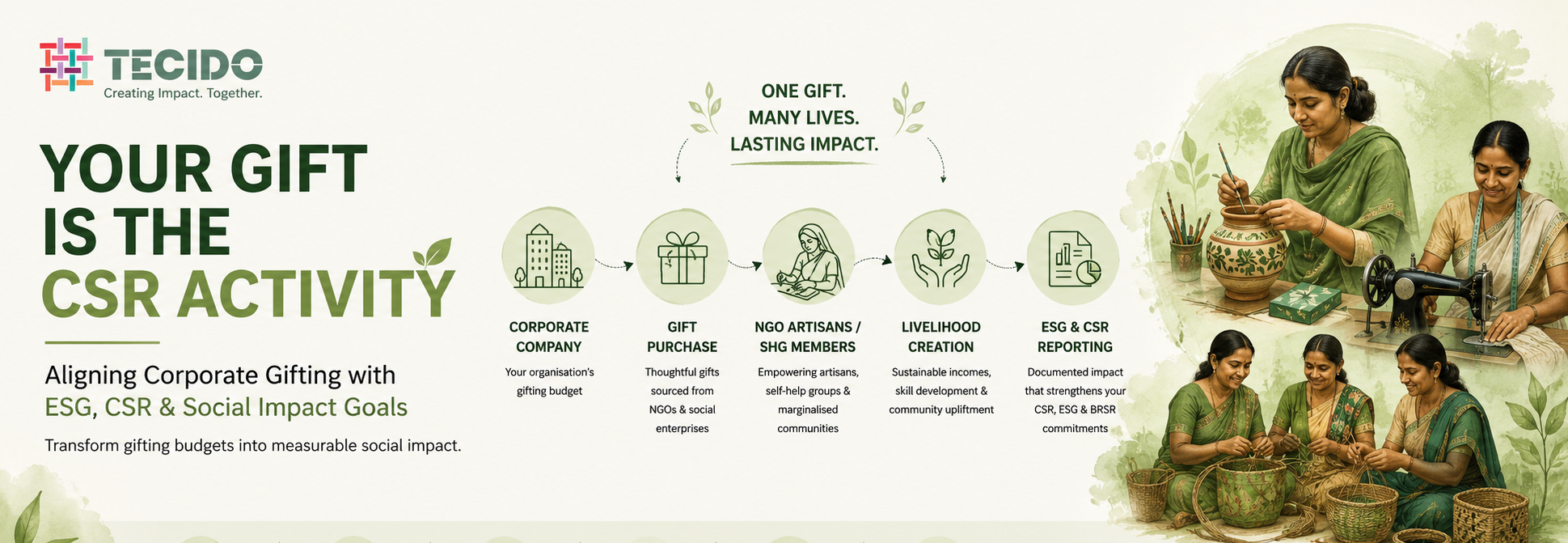
How to Align Corporate Gifting With Your Social Impact Goals
Most companies treat corporate gifting and CSR as entirely separate activities. The gifting team handles the Diwali hampers. The CSR team runs the education programme or the tree-planting drive. Never the twain shall meet.
But what if they could? What if the ₹5,000 your company spends per employee on annual gifting was also creating documented, reportable social impact — the kind that counts toward your ESG commitments and your Section 135 CSR obligations?
That is the argument we want to make in this piece. And the mechanism is simpler than most companies realise: gift products made by NGOs.
The ₹14,000 crore opportunity
India's corporate gifting market is valued at ₹14,000 crore in 2025, growing at over 8% per year. This is a significant pool of corporate spending — and right now, almost none of it is being directed toward social impact in any meaningful, documented way.
Companies spend this money on branded merchandise, festive hampers, and consumer products made by conventional manufacturers. The economic benefit stays largely with the supply chain. The artisans, self-help groups, and NGO-supported communities that could benefit from even a fraction of this spending remain invisible.
Meanwhile, those same companies are separately running CSR programmes, filing BRSR reports, and trying to meet ESG expectations from investors and boards. Two significant activities, happening in parallel, with no connection between them.
Section 135 and what counts as CSR
Under Section 135 of the Companies Act 2013, companies meeting certain turnover, net worth, or profit thresholds are required to spend at least 2% of their average net profits on CSR activities. The activities must align with Schedule VII of the Act, which includes:
• Livelihood enhancement projects
• Promotion of education and vocational skills
• Welfare of differently abled persons
• Women's empowerment and gender equity
• Protection of national heritage, art, and culture
Now look at that list again. Every single item maps directly to the work that NGO gifting organisations support. Women's self-help groups are livelihood enhancement. Organisations training people with disabilities are promoting vocational skills and welfare of differently-abled persons. Tribal craft NGOs are protecting national heritage, art, and culture.
Purchasing products from these organisations — especially in structured, documented programmes — can be aligned with and contribute to your CSR strategy. Consult your CSR and legal team to confirm applicability for your specific situation, but the strategic logic is clear: your gift and your CSR need not be separate.
The BRSR dimension
For listed companies, the Business Responsibility and Sustainability Reporting (BRSR) framework — mandated by SEBI — requires disclosure across environmental, social, and governance dimensions. The social dimension explicitly covers:
• Employment and livelihoods of marginalised communities
• Supply chain social responsibility
• Engagement with local and disadvantaged communities
An NGO gifting programme, properly documented, speaks directly to all three. It demonstrates that your supply chain includes socially responsible producers. It shows engagement with disadvantaged communities — artisans, women in SHGs, people with disabilities. And it creates a measurable livelihood impact that can be reported with specificity: artisans employed, income generated, NGOs supported.
This is the kind of data that institutional investors, rating agencies, and ESG auditors are increasingly looking for — and that most gifting programmes cannot currently provide.
What this looks like in practice
A mid-sized Indian company with 2,000 employees decides to shift 30% of its annual gifting spend toward NGO-made products. At ₹2,000 per person for the main Diwali gift, that is ₹12 lakh directed toward NGO artisans over a single festive season.
Specifically, they choose:
• Onboarding welcome kits: handcrafted stationery sets from GiftAbled (artisans with disabilities)
• Diwali gifts: curated hampers from Boxes of Goodness (women's SHG products + disability artisans)
• Work anniversary gifts: handloom products from Dastkar (rural women weavers)
The NGO partners provide impact documentation: the number of artisan hours worked, the average income earned per artisan per order, and the NGO's registration and 80G details. The company includes this data in its BRSR filing and its annual CSR report. The CFO is satisfied. The CSR team has a story to tell. The HR team sees employees genuinely moved by the gifting experience. And 200+ artisans have been paid fairly for their skill.
This is not a hypothetical. It is exactly what companies like Dell, Vedantu, and several large financial services firms are already doing with NGO gifting partners in India.
How to build the business case internally
The most common obstacle to NGO gifting at corporate scale is not cost or quality — it is internal alignment. Here is how to build the case:
• To the CFO: NGO gifting costs are comparable to conventional gifting at equivalent quality tiers. The difference is the story and the impact — both of which reduce the cost of ESG and CSR reporting by generating organic documentation.
• To the CSR team: This is a gifting programme that doubles as a livelihood programme. It is measurable, reportable, and visible — unlike many conventional CSR activities that are one-off and hard to communicate.
• To the HR team: Employee response to NGO gifting is consistently stronger than to conventional gifts. People feel proud to work for a company that gifts this way — and they talk about it.
• To the CEO: In a landscape where ESG is increasingly a competitive differentiator for talent and institutional investment, a documented NGO gifting programme is a visible, authentic signal of values — not just compliance.
"The most powerful thing about NGO gifting is that it turns every single gift into a story your company is proud to tell. That is rare. Most companies spend money on gifts no one remembers." — Liane Alfred
Getting started
You do not need to overhaul your entire gifting programme overnight. Start with one occasion. One NGO. One batch of gifts. Document the impact. Share the story. Watch what happens.
Most companies that start with NGO gifting expand it significantly in year two — because the response from employees, clients, and leadership is almost always the same: why didn't we do this sooner?
Tecido helps companies build NGO gifting programmes that are beautiful, reliable, and fully documented for CSR and ESG reporting. Write to us at info@tecidoglobal.com to start a conversation.
Tecido Global
Your trusted partner for corporate gifting and branded merchandise. We are a team of passionate, creative individuals helping brands build stronger identities through thoughtful, high-quality merchandise that leaves a lasting impression. From concept to doorstep — end-to-end, on time, every single time.
Quick Links
Contact Info
- info@tecidoglobal.com
- (+91) 98924 67276
- (+91) 93213 02123
-
VERDE TECIDO GLOBAL LLP
20th Floor, Commerz II, Oberoi Garden City,
Off Western Express Highway, Goregaon (E),
Mumbai - 400063
GST: 27AAZFV9492L1ZP
MSME Reg.: UDYAM-MH-33-0649603


© 2026 Tecido Global | All Right Reserved