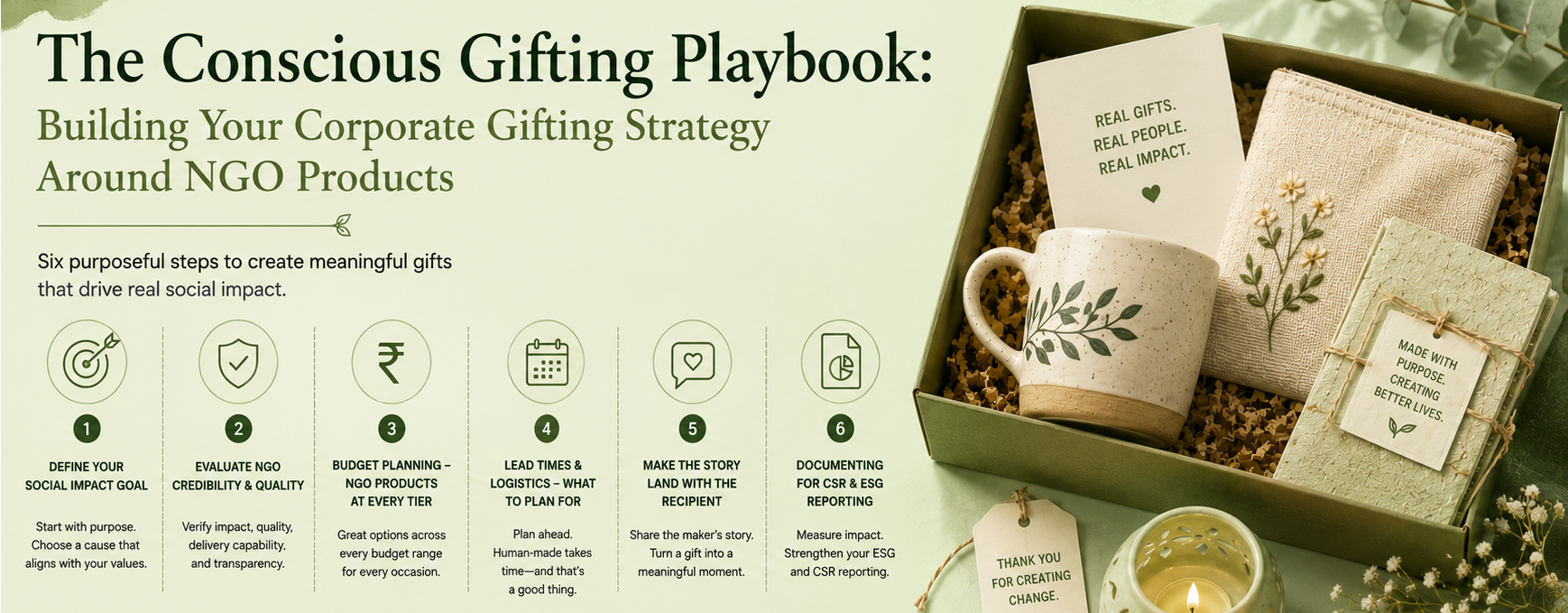
The Conscious Gifting Playbook: Building Your Corporate Gifting Strategy Around NGO Products
More and more Indian companies are asking the same question: we want our corporate gifting to mean something beyond a branded pen or a festive hamper. Where do we start?
If you are serious about building a gifting programme that creates genuine social impact — not just environmental compliance — this guide is for you. It walks through the six steps to building a meaningful NGO gifting strategy, from defining your intent to documenting your impact for ESG reporting.
Step 1: Define your social impact goal
Before choosing a product or an NGO, get clear on what your company actually cares about. The most effective NGO gifting programmes are built around causes that align authentically with the company's values or its workforce's demographics.
Common focus areas for Indian corporates:
• Women's economic empowerment: particularly resonant for companies with large female workforces or gender equity goals
• Disability inclusion: aligns with broader DEI (Diversity, Equity, Inclusion) commitments and Section 135 CSR eligibility
• Rural livelihood & tribal craft: meaningful for companies with operations in or connection to rural India
• Child welfare & education: emotionally powerful and universally relatable across recipient groups
• Artisan heritage preservation: resonant for companies in textiles, design, or culture-adjacent industries
You do not need to pick one cause forever. Many companies rotate their NGO gifting focus — Diwali gifts from a women's SHG, onboarding kits from a disability-focused organisation, anniversary gifts from a tribal craft NGO.
Step 2: Evaluate NGO credibility and quality
Not all NGOs are equally positioned to supply corporate gifts at scale. Here is what to look for before committing to an order:
1. Registration and certification — verify that the NGO is registered (Section 8 company or Trust), holds 80G tax exemption, and has current FCRA registration if applicable
2. Impact documentation — ask for an annual report or impact brief showing the number of beneficiaries, income generated, and programme outcomes
3. Product quality and consistency — request physical samples before placing bulk orders. Quality should be consistent across the batch, not just the sample
4. Delivery capability — confirm that the NGO (or its platform partner) can deliver to your required pincodes within your timeline
5. Communication responsiveness — a well-run NGO gifting operation will have a designated contact for corporate orders and respond within 48 hours
If direct NGO sourcing feels complex, platforms like Humanitive, Jhappi, and Boxes of Goodness curate vetted NGO products and handle logistics — making it much simpler for your procurement team.
Step 3: Budget planning — NGO products at every tier
A common misconception is that NGO products are either very cheap (charity-priced) or very expensive (artisan-premium). In reality, the range is broad and comparable to conventional corporate gifting:
• Entry level (₹200–₹600): handmade candles, handpainted diyas, artisan chocolates, embroidered keychains, handmade cards
• Mid range (₹600–₹2,000): handwoven tote bags, ceramic mugs, artisan stationery sets, handcrafted jewellery, embroidered cushion covers
• Premium (₹2,000–₹6,000): handloom silk products, curated NGO hampers with 4–6 items, custom artisan pieces, handcrafted leather goods
For large orders (500+ units), pricing often improves significantly and custom branding — your company logo subtly incorporated into the product or packaging — is usually possible with sufficient lead time.
Step 4: Lead times and logistics — what to plan for
NGO-made products require more planning than factory-made gifts. This is not a weakness — it is a reflection of the human process behind them. Build the following into your calendar:
• 10–12 weeks before Diwali: begin NGO partner conversations, review catalogues, request samples
• 8 weeks before: finalise order, confirm quantity, approve any custom branding or packaging
• 6 weeks before: order placed and confirmed with NGO; production underway
• 2–3 weeks before: delivery received, quality check completed, gift packing arranged
• 1 week before: distribution to employees/clients, impact cards inserted
For smaller orders or evergreen gifting (new hire kits, client appreciation, work anniversaries), 4–6 weeks lead time is generally sufficient for most NGO partners.
Step 5: Making the story land with the recipient
The single most important thing you can do to maximise the impact of an NGO gift is to tell the story. A handpainted ceramic mug is a lovely gift. A handpainted ceramic mug made by Sunita, a visually impaired artisan from Pune who learned ceramic art through the Kshitij Foundation, is a gift people remember and talk about.
Practical ways to communicate the story:
• Insert a physical story card in every gift — the maker's first name, their community, what the NGO does, and the impact the purchase creates
• Include a QR code linking to a short video or page about the NGO and its work
• Send a follow-up email to all recipients 2–3 days after gifting, reinforcing the impact story and any specific NGO partnership details
• Share the story on LinkedIn and internal comms — "this year, our Diwali gifts were made by..." — employees respond powerfully to this
Step 6: CSR and ESG reporting
If your company falls under Section 135 of the Companies Act — mandatory CSR spending for companies above a turnover or profit threshold — NGO gifting can be documented as part of your social impact contribution.
It also gives your CSR team a meaningful, visible, story-driven programme to communicate — internally, to your board, and to the public.
"The gift is the conversation starter. The story is what makes it memorable. Together, they create the kind of moment that employees and clients associate with your company for years." — Harsh Panchal
Tecido helps companies build NGO gifting programmes from sourcing to delivery to impact documentation. Write to us at info@tecidoglobal.com to get started.
Tecido Global
Your trusted partner for corporate gifting and branded merchandise. We are a team of passionate, creative individuals helping brands build stronger identities through thoughtful, high-quality merchandise that leaves a lasting impression. From concept to doorstep — end-to-end, on time, every single time.
Quick Links
Contact Info
- info@tecidoglobal.com
- (+91) 98924 67276
- (+91) 93213 02123
-
VERDE TECIDO GLOBAL LLP
20th Floor, Commerz II, Oberoi Garden City,
Off Western Express Highway, Goregaon (E),
Mumbai - 400063
GST: 27AAZFV9492L1ZP
MSME Reg.: UDYAM-MH-33-0649603


© 2026 Tecido Global | All Right Reserved