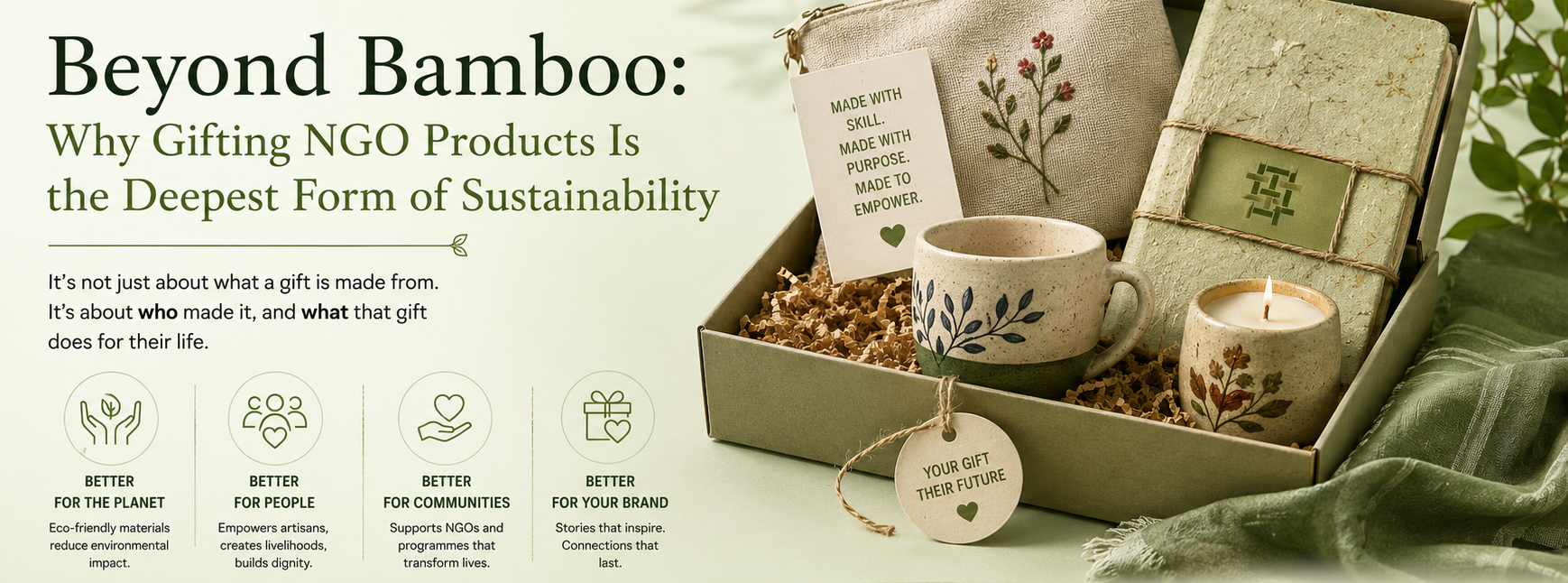
Beyond Bamboo: Why Gifting NGO Products Is the Deepest Form of Sustainability
When most companies talk about sustainable corporate gifting in India, the conversation quickly turns to materials. Bamboo bottles. Seed paper notebooks. Jute tote bags. Recycled cotton tees. These are good choices — genuinely better than plastic and synthetics — and we are glad to see them gaining ground. But at Tecido, we have been asking a deeper question: is material sustainability enough? And the answer, increasingly, is no.
The most meaningful form of sustainable gifting is not just about what a gift is made from. It is about who made it, and what that gift does for their life.
What the industry means by "sustainable" today
Scan the blogs of any corporate gifting company in India, and their definition of sustainability follows a predictable pattern: eco-friendly materials, recyclable packaging, low carbon footprint. These are environmental sustainability measures — and they matter.
But they tell only half the story. They address the impact of a gift on the planet. They say almost nothing about the impact of a gift on people.
There is a second dimension of sustainability that the corporate gifting industry has largely ignored: social sustainability — the idea that a gift can create meaningful, lasting change in the life of the person who made it.
What NGO products actually are
Across India, hundreds of NGOs, self-help groups (SHGs), social enterprises, and not-for-profit organisations support communities that are often invisible to the mainstream economy:
• Women from low-income communities, trained in handicrafts, embroidery, handloom weaving, and leather work through self-help groups across Maharashtra, Rajasthan, West Bengal, and Tamil Nadu
• People with physical or intellectual disabilities, employed to make candles, ceramics, chocolates, stationery, and handpainted goods in cities like Mumbai, Bengaluru, and Hyderabad
• Tribal and rural artisans from Assam, Odisha, Madhya Pradesh, and Uttarakhand, keeping centuries-old craft traditions alive through organisations that give them a market
• Visually impaired craftspeople, individuals on the autism spectrum, and others whose professional potential is deeply underestimated — until a well-designed gifting programme changes that
These artisans and makers produce objects of genuine beauty and quality — handpainted diyas, hand-stitched bags, artisan chocolates, ceramic mugs, embroidered cushion covers, handmade paper stationery, and much more. These are not "charity products." They are exceptional gifts.
The double impact of an NGO gift
When a company gifts a bamboo bottle, the environmental benefit is real — a piece of plastic avoided. But the social chain ends there. The factory that made the bottle is not necessarily paying fair wages, employing marginalised communities, or building lives.
When a company gifts a handpainted diya made by a woman at the Women's India Trust in Mumbai, or a ceramic mug made by an artisan with intellectual disabilities at Kshitij, something different happens:
• The recipient receives a beautiful, unique, handcrafted gift with a story worth telling
• The maker earns a fair wage for skilled work — often the first consistent income of their life
• The NGO receives the revenue it needs to continue its programmes, train more artisans, and expand its reach
• The buying company demonstrates a form of corporate citizenship that goes beyond a compliance checkbox
"A recycled product reduces harm. An NGO product creates good. Both matter — but only one of them changes a life." — Priti Bhandari, Co-Founder & CEO, Tecido Global
Why this matters for your company specifically
The companies we work with — MNCs, tech firms, pharma companies, financial services — are under increasing pressure to demonstrate ESG commitments that are authentic and measurable. A bamboo notebook checks a box. An NGO-made gift tells a story that your employees will actually share.
Consider what happens when a new employee opens a welcome kit containing a handcrafted item with a card that says: "This notebook was made by Anita, a single mother from Jalgaon who learned bookbinding through a women's self-help group. Your purchase funds her training programme and her children's schooling." That moment of connection — between the gift, the recipient, and the maker — is something no branded merchandise can replicate.
This is the difference between sustainable gifting and meaningful gifting.
Bringing it together into your gifting strategy
We are not suggesting that every corporate gift needs to come from an NGO. There is a place for branded merchandise, tech accessories, and premium hampers in a comprehensive gifting strategy. But we do believe that every company should make NGO products a conscious part of that strategy — not an afterthought, not a once-a-year CSR gesture, but a regular, visible, intentional choice.
Practically, this means:
1. Designating at least one gifting occasion per year — Diwali, employee recognition, new hire welcome — where NGO-made products are specifically chosen
2. Including the maker's story with every NGO gift — a card, a QR code, a note — so the recipient understands the impact their company has created
3. Documenting NGO gifting in your CSR reports, where it genuinely contributes to social impact metrics under Section 135 of the Companies Act
4. Choosing NGO partners that align with your company's specific values — women's empowerment, disability inclusion, rural livelihoods, tribal craft preservation
The gifting industry in India is ₹14,000 crore and growing. Imagine if even 10% of that were directed towards products made by NGOs and self-help groups. The livelihoods that would be sustained. The children whose education would be funded. The dignity that would be restored.
That is the deeper form of sustainability we are talking about. And it starts with the next gift you give.
Tecido curates NGO-made corporate gifts across every budget and occasion. Contact us at info@tecidoglobal.com or +91 98924 67276 to explore how we can build an NGO gifting programme for your company.
Tecido Global
Your trusted partner for corporate gifting and branded merchandise. We are a team of passionate, creative individuals helping brands build stronger identities through thoughtful, high-quality merchandise that leaves a lasting impression. From concept to doorstep — end-to-end, on time, every single time.
Contact Info
- info@tecidoglobal.com
- (+91) 98924 67276
- (+91) 93213 02123
-
VERDE TECIDO GLOBAL LLP
20th Floor, Commerz II, Oberoi Garden City,
Off Western Express Highway, Goregaon (E),
Mumbai - 400063
GST: 27AAZFV9492L1ZP
MSME Reg.: UDYAM-MH-33-0649603


© 2026 Tecido Global | All Rights Reserved