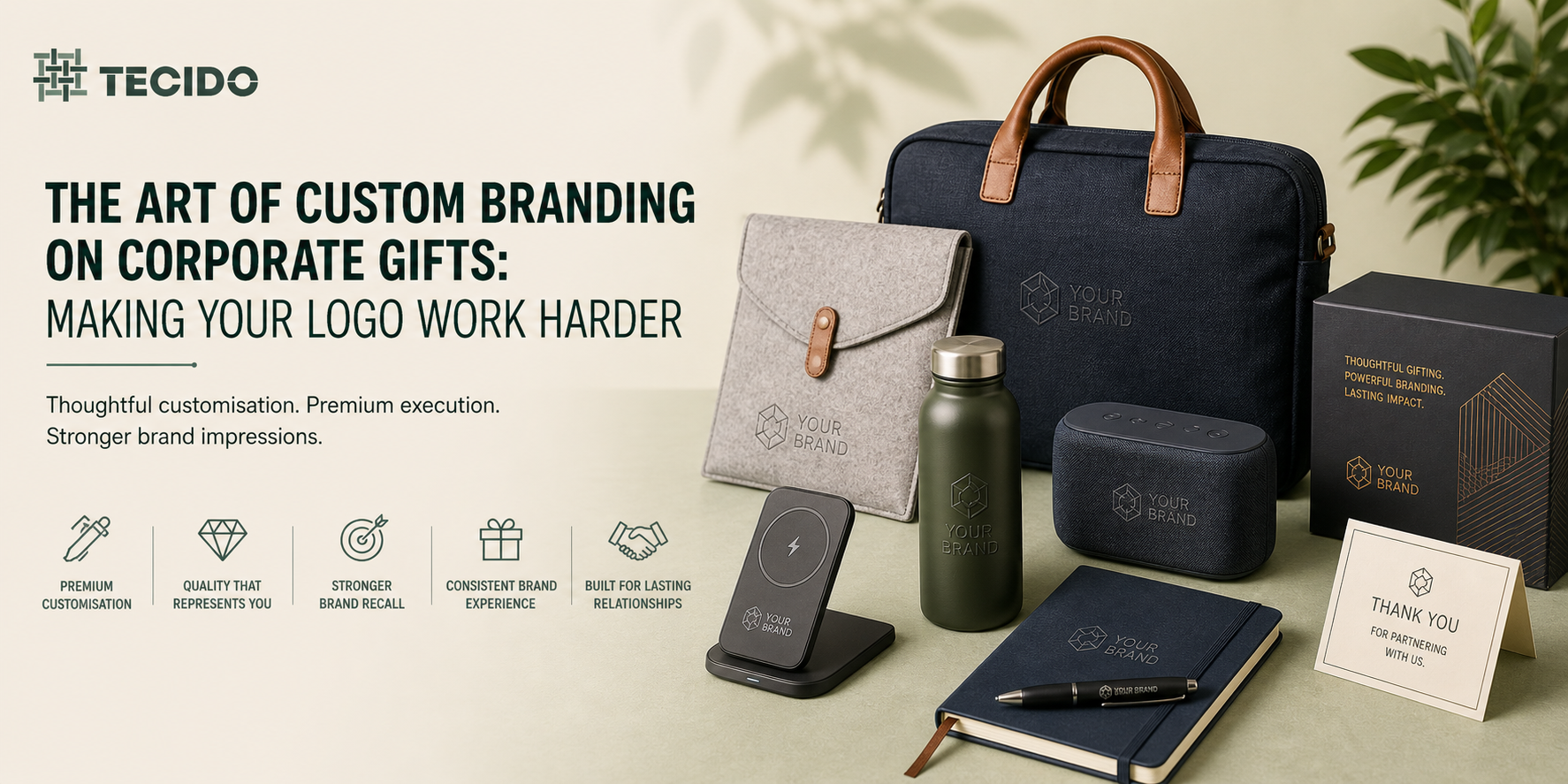
The Art of Custom Branding on Corporate Gifts: Making Your Logo Work Harder
Every corporate gift is a branded touchpoint. But there is a significant difference between a logo slapped on a product and a brand beautifully expressed through a thoughtfully customised gift. The first is a transaction. The second is a brand moment.
As a company that handles in-house branding and customisation, we have seen both done well and done poorly. This guide covers what it actually takes to get custom branding right on corporate gifts.
Why customisation matters in B2B gifting
In B2B relationships, your gift is a physical ambassador for your company. The quality of the customisation — the precision of the logo, the choice of placement, the coherence of colours, the finish of the technique — tells the recipient something about how you operate. A crisp, beautifully embossed logo on a premium notebook says "we pay attention to detail." A faded, slightly off-centre print on a cheap mug says the opposite.
Brand recall data supports this: promotional products with high-quality branding generate 2.5x more brand impressions than their unbranded equivalents, and recipients are significantly more likely to associate premium-quality branded gifts with premium-quality companies.
The six main customisation techniques — and when to use each
• Screen printing: best for large, flat surfaces — t-shirts, tote bags, cotton pouches. Cost-effective at volume, excellent for bold logos and multi-colour designs. Not suitable for very fine detail or metallic finishes.
• Embroidery: best for fabric items — caps, polos, jackets, bags. Creates a premium, textured feel. Very durable and washable. Works best for logos with 3–5 colours and no very fine lines.
• Laser engraving: best for metal, wood, leather, and glass — bottles, notebooks, pens, coasters. Creates a permanent, elegant mark. Especially premium for executive and client gifts. No colour — monochrome only.
• UV printing: best for hard surfaces — drinkware, tech accessories, acrylic items. Full colour, photo-quality reproduction. Allows complex gradients and detailed artwork. Highly resistant to fading.
• Embossing and debossing: best for leather and faux-leather — notebooks, cardholders, laptop sleeves. Creates a dimensional, tactile impression. Extremely premium feel. Often used for executive gifting.
• Sublimation: best for polyester fabrics and ceramic items — mugs, mousepads, apparel. Full-colour, edge-to-edge printing. Particularly effective for photographic or highly detailed full-surface designs.
Getting the logo placement right
Logo placement is one of the most under-discussed aspects of corporate gift customisation. The standard "centre-chest" placement on a t-shirt or "front-centre" on a mug is not always the most effective choice. Consider:
• Subtle placement for premium gifts — a small, precise engraving on the bottom corner of a notebook cover signals confidence rather than desperation for attention
• Sleeve or inner placement for apparel — a logo on the inner collar or the sleeve hem gives branded apparel a fashion-forward feel rather than a corporate-uniform feel
• Integrated design for packaging — incorporate the brand colour throughout the packaging, not just the logo on top, for maximum visual coherence
• Recipient-forward personalisation — for the most premium gifts, lead with the recipient's name rather than your company logo. Their name first, your brand second — this is the subtle shift that makes a gift feel like a gift, not a marketing material
Artwork guidelines for the best results
The quality of the output is only as good as the artwork you provide. For best results:
1. Always provide vector files (.AI, .EPS, or .PDF with outlined fonts) — raster images (JPEG, PNG) cannot be scaled without quality loss
2. Specify Pantone colour codes, not just hex or RGB — Pantone ensures colour consistency across different materials and printing techniques
3. Provide a simplified version of your logo for small placements — fine details that work on a website do not survive engraving or embroidery at 2cm
4. Brief your gifting partner on brand guidelines — spacing rules, minimum clear space around the logo, colours that must never be used together
Packaging as a branding medium
Many companies spend significant thought on logo placement on the gift itself, then use generic packaging. This is a missed opportunity. The box, the tissue paper, the ribbon, the insert card, and even the outer mailer are all branding surfaces. A consistent brand experience from the moment the package arrives to the moment the gift is unwrapped creates an impression that generic packaging cannot.
For Tecido clients, we offer custom-branded boxes in brand colours, tissue paper with logo print, personalised insert cards, and branded ribbon — all designed to ensure the unboxing experience is coherent with the gift itself.
"A gift with a perfectly placed, beautifully executed logo tells the recipient: we care about how we show up in the world. That is exactly the message you want your brand to send." — Vignesh Sanil, BD Manager, Tecido Global
Tecido offers full in-house branding and customisation across all major techniques. Contact us at info@tecidoglobal.com to discuss your customisation requirements.
Tecido Global
Your trusted partner for corporate gifting and branded merchandise. We are a team of passionate, creative individuals helping brands build stronger identities through thoughtful, high-quality merchandise that leaves a lasting impression. From concept to doorstep — end-to-end, on time, every single time.
Contact Info
- info@tecidoglobal.com
- (+91) 98924 67276
- (+91) 93213 02123
-
VERDE TECIDO GLOBAL LLP
20th Floor, Commerz II, Oberoi Garden City,
Off Western Express Highway, Goregaon (E),
Mumbai - 400063
GST: 27AAZFV9492L1ZP
MSME Reg.: UDYAM-MH-33-0649603


© 2026 Tecido Global | All Rights Reserved